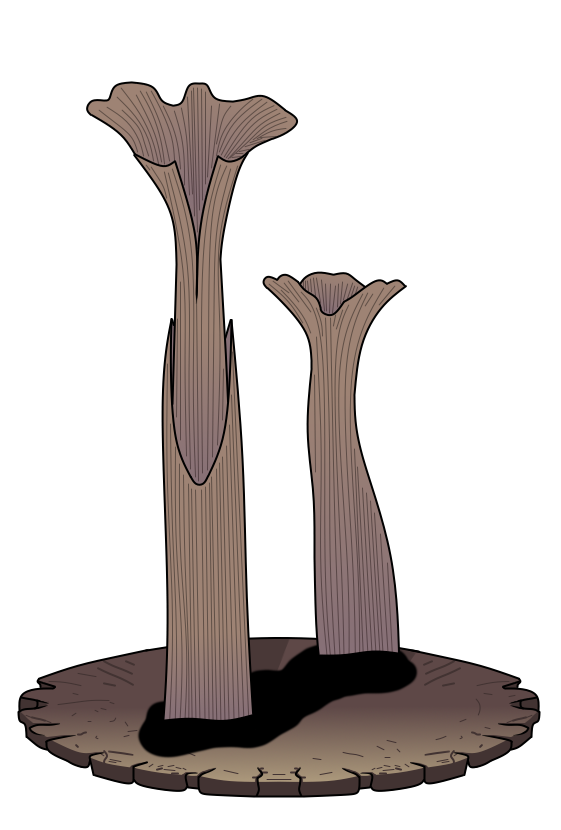
The Coral Split Tube is an underwater plant most commonly found within the Korkik Sea, particularly along the borders of the Soronic Mountains and Malda Mountains. As its name suggests, its most distinctive feature is a prominent split running from the top to the base along its front side, while the back typically develops into a broader, more reinforced structure. Interestingly, the Coral Split Tube can grow in multiple layered formations, with each layer strengthening the one beneath it to withstand underwater seismic activity. In the specimen shown here, the front displays a dual-layered structure, where the lower portion thickens and splits open, allowing a new tube to emerge from within, while the rear maintains a single-layer formation.
Studies suggest that over many generations, this species has gradually evolved to develop additional layers as an adaptive response to frequent underwater earthquakes in the southern Korkik Sea. Its coloration ranges from muted browns to sand-worn tans, enabling it to blend naturally with the seabed. Most Coral Split Tubes grow to an average height of 1.5 meters, though both smaller and significantly larger specimens have been recorded.
Some Earth-born researchers have questioned its classification, arguing that coral is typically fauna rather than flora. However, due to the combined research efforts of scientists from many races across Astracel, consensus has been reached: based on both behavior and structure, the Coral Split Tube functions as flora. This classification has since been officially recognized by the Inser Foundation, established during the Great Peace Treaty.